Wednesday, August 22, 2018

National Monument World

    National Monument World

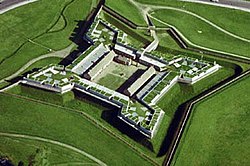
       Fort Stanwix National Monument

Fost areal image007.jpg
Fort Stanwix 
Fort Stanwix ::- Fort Stanwix National Monument is a United States National Historic Site in Rome, New York, managed by the National Park Service (NPS). The current fort is a reconstruction of the historic Fort Stanwix occupying approximately 16 acres (6.5 ha) of downtown Rome. The fort site—although not the reconstruction itself—is listed in the National Register of Historic Places.

Fort Stanwix is historically significant because of its successful defense by American troops during an August 1777 siege. The fort had been built by the British in 1758 at a strategic site along the water route from Lake Ontario to the Hudson River

           Statue of Liberty National Monument

Statue of Liberty
Statue of Liberty ::-The Statue of Liberty National Monument is a United States National Monument located in the U.S. states of New Jersey and New York comprising Liberty Island and Ellis Island.[5] It includes Liberty Enlightening the World, commonly known as the Statue of Liberty, situated on Liberty Island, and the former immigration station at Ellis Island which opened in 1892 and closed in 1954. The monument is managed by the National Park Service as part of the National Parks of New York Harbor office.


                Fort Matanzas National Monument

Ft Matanzas 2008.JPG
Fort Matanzas
Fort Matanzas ::-Fort Matanzas National Monument was designated a United States National Monument on October 15, 1924. The monument consists of a 1740 Spanish fort called Fort Matanzas, and about 100 acres (0.4 km²) of salt marsh and barrier islands along the Matanzas River on the northern Atlantic coast of Florida. It is operated by the National Park Service in conjunction with the Castillo de San Marcos National Monument in the city of St. Augustine.


                  Navajo National Monument

Navajo
 Navajo ::-Navajo National Monument is a National Monument located within the northwest portion of the Navajo Nation territory in northern Arizona, which was established to preserve three well-preserved cliff dwellings of the Ancestral Puebloan People: Broken Pottery (Kitsʼiil), Ledge House (Bitátʼahkin), and Inscription House (Tsʼah Biiʼ Kin). The monument is high on the Shonto plateau, overlooking the Tsegi Canyon system, west of Kayenta, Arizona. It features a visitor center with a museum, two short self-guided mesa top trails, two small campgrounds, and a picnic area. Rangers guide visitors on free tours of the Keet Seel and Betatakin cliff dwellings. The Inscription House site, further west, is currently closed to public access.

INDIAN 05 TOP TEMPALE


                                      -:: INDIAN 05 TOP  TEMPALE  ::-


Brihadeswara Temple
01.Brihadeswara Temple ::-Brihadeswara Temple built by Raja Raja I, a UNESCO World Heritage Site Main article: Brihadisvara TempleIn 1010 AD, Raja Raja built the Brihadeswara Temple in Thanjavur dedicated to Lord Shiva. The temple and the capital acted as a center of both religious and economic activity. It is also known as Periya Kovil, RajaRajeswara Temple and RajarajeswaramThe temple is part of the UNESCO World Heritage Site known as the "Great Living Chola Temples",The vimanam (temple tower) is 216 ft (66 m) high and is the tallest in the world.
BRAHMA TEMPLE


02. Brahma Temple, Pushkar ::-Jagatpita Brahma Mandir  is a Hindu temple situated at Pushkar in the Indian state of Rajasthan, close to the sacred Pushkar Lake to which its legend has an indelible link. The temple is one of very few existing temples dedicated to the Hindu creator-god Brahma in India and remains the most prominent among them.The temple is made of marble and stone slabs. It has a distinct red pinnacle (shikhara) and a hamsa bird motif. The temple sanctum sanctorum holds the image of four-headed Brahma and his consort Gayatri. ] On Kartik Poornima, a festival dedicated to Brahma is held when large number of pilgrims visit the temple, after bathing in the sacred lake.


DWARAKADHIS TEMPLE
03.Dwarkadhish Temple ::-Akshardham or Swaminarayan Akshardham complex is a Hindu temple, and a spiritual-cultural campus in Delhi, India. Also referred to as Akshardham Temple or Swaminarayan Akshardham, the complex displays millennia of traditional Hindu and Indian culture, spirituality, and architecture. Inspired by Yogiji Maharaj and created by Pramukh Swami Maharaj, it was constructed by BAPS.
he temple, which attracts approximately 70 percent of all tourists who visit Delhi, The temple, at the centre of the complex, was built according to the Vastu shastra and Pancharatra shastra.
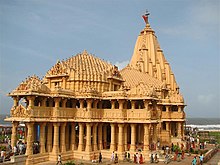
Image of temple
04. Somnath temple ::-The Somnath temple located in Prabhas Patan near Veraval in Saurashtra on the western coast of Gujarat, is believed to be the first among the twelve jyotirlinga shrines of Shiva. It is an important pilgrimage and tourist spot of Gujarat. Reconstructed several times in the past after repeated destruction by several Muslim invaders  and Portuguese, the present temple was reconstructed in Chaulukya style of Hindu temple architecture and completed in May 1951

The headquarters of the NarNarayan Dev Gadi05.Swaminarayan Temple::-Shree Swaminarayan Mandir Kalupur is the first temple of the Swaminarayan Sampraday, a Hindu sect. It is located in Kalupur area of Ahmedabad, the largest city in Gujarat, India. It was built on the instructions of Swaminarayan Bhagwan, the founder of the sect.
As per the will of Swaminarayan, the administration of the Swaminarayan Sampraday is divided into two Gadis (seats) - NarNarayan Dev Gadi and LaxmiNarayan Dev Gadi. This temple is the headquarters of the NarNarayan Dev Gadi.Green and yellow sculptures of Hindu gods and goddesses, their bodies fitted in opulent dress, cover the structure of this nineteenth-century temple.

Tuesday, August 21, 2018

RAJASTHAN Culture

                              -:: RAJASTHAN Culture ::-


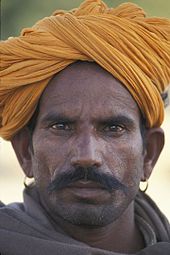
       01. Dress :- Men wear dhotis ,kurta,Angarkha and Paggari or SAfa (kind of turbanheadgear). Traditional Chudidar payjama (puckered trousers) frequently replaces dhoti in different regions. Women wear ghagra (long skirt) and kanchli (top). However, dress style changes with lengths and breaths of vast Rajasthan. Dhoti is worn in different ways in Marwar (Jodhpur area) or Shekhawati (Jaipur area) or Hadoti (Bundi area). Similarly, there are a few differences pagri and safa despite both being Rajasthani headgear. Mewar has the tradition of paggar, whereas Marwar has the tradition of safa


 02. Music ::-Rajasthani Music has a diverse collection of musicians. Major schools of music includes Udaipur , Jodhpur and Jaipur  is a major Gharanas which is well known for its reverence for rare ragas. Jaipur-Atrauli Gharana  is associated with Alladiya Khan (1855–1943), who was among the great singers of the late 19th and early 20th century.Alladiya Khan  was trained both in Dhrupad and Khyal styles, though his ancestors were Dhrupad singers The most distinguishing feature of Jaipur Gharana is its complex and lilting melodic form


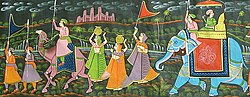
Rajasthani Painting.jpg03. Rajasthani paintings :;-The colorful tradition of Rajasthani people reflects in art of paintings as well. This painting style is called Maru-Gurjar painting. It throws light on the royal heritage of ancient Rajasthan. Under the Royal patronage, various styles of paintings developed, cultivated, and practiced in Rajasthan, and painting styles reached their pinnacle of glory by 15th to 17th centuries. The major painting styles are Phad Paintings. miniature paintingskajali paintingsgemstone paintings, etc. There is incredible diversity and imaginative creativity found in Rajasthani paintings. Major schools of art are Mewar, Marwar,kishangarh Bundi Kota And Jaipur And Alwar 


Monday, August 20, 2018

Balika Samridhi Yojana INDIA

                             -: Balika Samridhi Yojana :-
BALIKA SAMRIDHI YOJANA ::-

Introduction:
The scheme of Balika Samridhi Yojana was launched by Govt. of India w.e.f. 15-8-97 with the following objectives:-
1. To change negative family and community attitudes towards the girl child at birth and
    towards her mother.
2. To improve enrolment and retention of girl children in schools.
3. To raise the age at marriage of girls.
4. To assist the girl to undertake income generating activities.
     
COMPONENTS FO BALIK SAMRIDHI YOJNA ::-
From the start of the scheme, the mothers of newborn girl children were given a post delivery grant of Rs. 500/- each in cash as a gift from the Government. There was also provision for Annual Scholarships to the girl child for attending school. But the details /guidelines for scholarships were not received.
During 1999-2000, Govt. of India recast the scheme and the benefits and means of delivery have been redesigned to ensure that financial benefits accrue to the girl child. Now the girl children eligible under BSY are entitled to the following benefits:-
1.   A post birth grant amount of Rs. 500/-.
2.   When the girl child born on or after 15-08-1997 and covered under BSY starts attending
      the school, she will become entitled to annual scholorship as under for each successfully
       completed year of schooling:-
Class
Amount of Annual Scholarship
I-III
Rs. 300/- per annum for each class
IV
Rs. 500/- per annum
V
Rs. 600/- per annum
VI-VII
Rs. 700/- per annum for each class
VIII
Rs. 800/- per annum
IX-X
Rs. 1000/- per annum for each class

 COVERAGE
 Balika Samridhi Yojna is being implemented in both rural and urban areas.
  TARGET GROUP
Under Balika Samridhi Yojna girl children belonging to families below the poverty line are given benefit, who are born on or after 15th August,1997. The benefits are restricted to two girl children in a household irrespective of number of children in the household.
  PROCEDURE FOR OBTAINING THE BENEFIT
This scheme is being implemented through ICDS infrastructure in rural areas and through functionaries of Health Department in urban areas. The application forms are available with Anganwadi Workers in the villages and with Health functionaries in urban areas. The beneficiaries are required to submit the  filled in applications to these functionaries.
  DISBURSEMENT OF ASSISTANCE:
The amounts of post birth grant and scholarships are to be deposited in an interest bearing account to be opened in the name of the beneficiary girl child and an officer designated in this behalf by the State Govt. in the nearest bank or post office.The amount should earn the maximum possible rate of interest.In this context the Public Provident Fund scheme or the National Saving Certificate is given higher priority.
  FACILITY OF WITHDRAWAL:
A portion of the Post Birth Grant of Rs.500/- or the amount of the annual scholarship can be applied toward the sole purpose of paying the premium on an insurance policy in the name of the girl child under the Bhagyashri Balika Kalyan Bima Yojna. The amounts of annual scholarships can also be permitted to be utilised toward purchase of textbook or uniform for the girl child.The amount left after paymant shall be deposited in the account.
  PAYMENT AT MATURITY:
On the girl child attaining 18 years of age and on production of a certificate from the Gram Panchayat /Municipality that she is unmarried on her eighteenth birthday, the implementing agency would authorise the bank or the post office authorities concerned to allow her to withdraw the amount standing in her name in the interest bearing account.
  WITHDRAWAL OF THE BENEFIT:
In the event of the girl getting married before attaining the age of 18 years, she shall forgo the benefit of the amount of annual scholarships and the interest accrued thereon and shall stand entitled only to the Post Birth Grant amount of Rs.500/- and the interest accrued thereon. In the eventuality of the death of the girl child before attaining the age of 18 years, the accumulated amount in her account would be withdrawn.
  FUNDS :
Prior to 1999-2000 , funds were being released to the Additional Deputy Commissioners by the Govt of India.However. thereafter the funds were being released to the State Govt.
The year wise expenditure and beneficiaries is as under :-  
Sr. No.
Year
Amount released by GOI (Rs. in lacs )
Beneficiaries covered
1.
1997-98
86.49
2738
2.
1998-99
59.29
7765
3.
1999-2000
57.66
6673
4.
2000-01
25.00
2889
5.
2001-02
-
9166
6.
2002-03
-
6696
7.
2003-04
-
7441
8.
2004-05
63.29
2337 (tentative)


::  BALIKA SAMRIDHI YOJANA ::
 Application Form for obtaining the post-birth benefit of Rs. 500/- (for rural areas)
                                                                                            
                                                                                                   
 Application Form for obtaining the post-birth benefit of Rs. 500/- (for urban areas)


Symbols of Rajasthan

               ::-  Symbols of Rajasthan ::-
01. Dance:- Ghoomar is a traditional Flok Dance of Bhil tribe performed to worship Goddess Sarasvati which was later embraced by other Rajasthani communities.[The dance is chiefly performed by veiled women who wear flowing dresses called ghaghara.It was ranked 4th in the list of "Top 10 local dances around the world" in 2013.The dance typically involves performers pirouetting while moving in and out of a wide circe


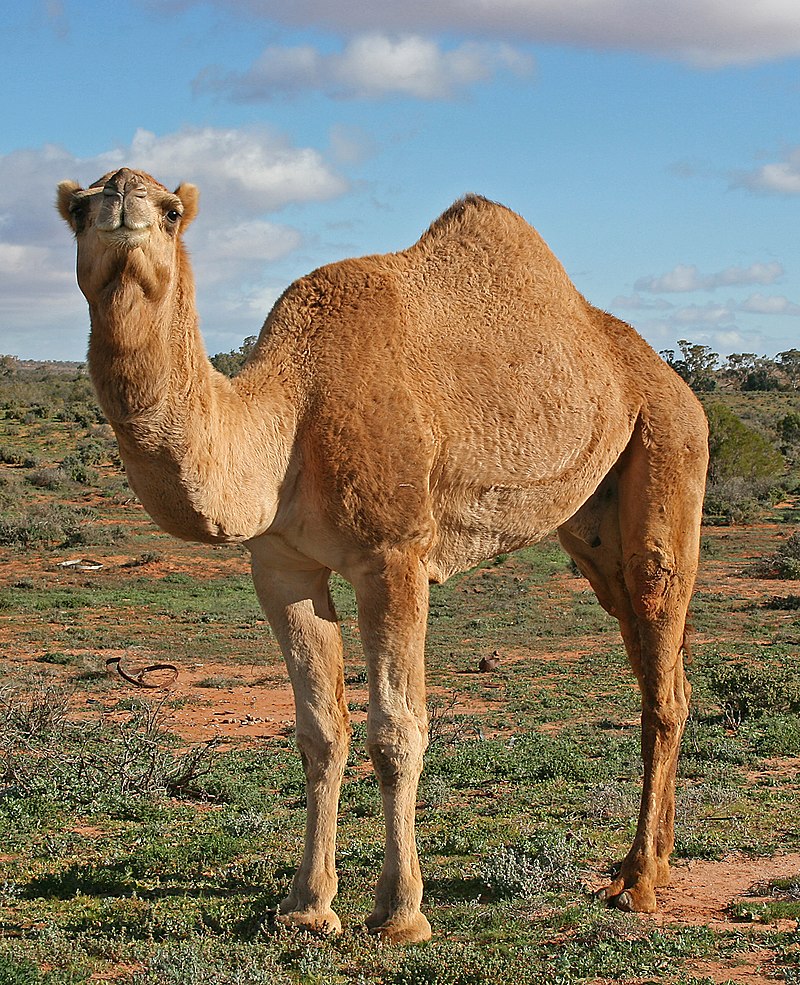
A one-humped camel


02.Animal :- camel is an Even-toed ungulate  in the genus Camelus that bears distinctive fatty deposits known as "humps" on its back. Camels have long been domesticated and, asLive Stok, they provide foo


Chinkara at Ranthambore.jpg
Animal :- The chinkara, also known as the Indian gazelle, is a gazelle species native to Iran, Afghanistan, Pakistan and India.


Tecomella undulata tree in Alamarvdasht, Fars, Iran, by Hadi Karimi.jpg


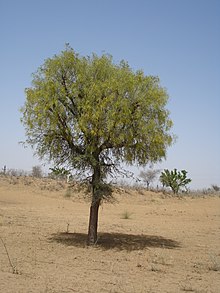
03.Flower :-is a Tree Species,locally known as rohida found in Thar Desertregions of INDIA and Pakishant. It is a medium-sized Tree that produces quality Timbertand is the main source of timber amongst the indigenous tree species of desert regions of Shekhwati and Marwar in Rajasthan. The trade name of the tree species is desert teak or Marwar teak.


Khejri.jpg


04. Tree :-  known as ShamiKhejri Tree, or Ghaf, is a species of Floweringtree in the Pea family, Fabaceae. It is native to Arid portions of Western Asia  and the Indian subcontinent I, including Afghanistan, Bahrain, Iran, India, Oman, Pakistan, Saudi Arabia, the United Arab Emirates and Yemen


Saturday, August 4, 2018

MY VILLAGE SMART CITY


                  MY VILLAGE FIRST SARAB BANDI ABIYAN KACHHALI MANDAWAR